
← Free sailing teaching resources
Printable points of sail cheat sheet and parts of a sailboat worksheets
Seven pages: a points of sail cheat sheet, three labelled parts of a sailboat pages, and three blank worksheets. The labelled pages are the answer key. Free to print and hand out; please leave the credit line on.
To print only some pages, choose them in your printer's page range. To save a PDF, pick “Save as PDF” as the printer.
Points of sail cheat sheet
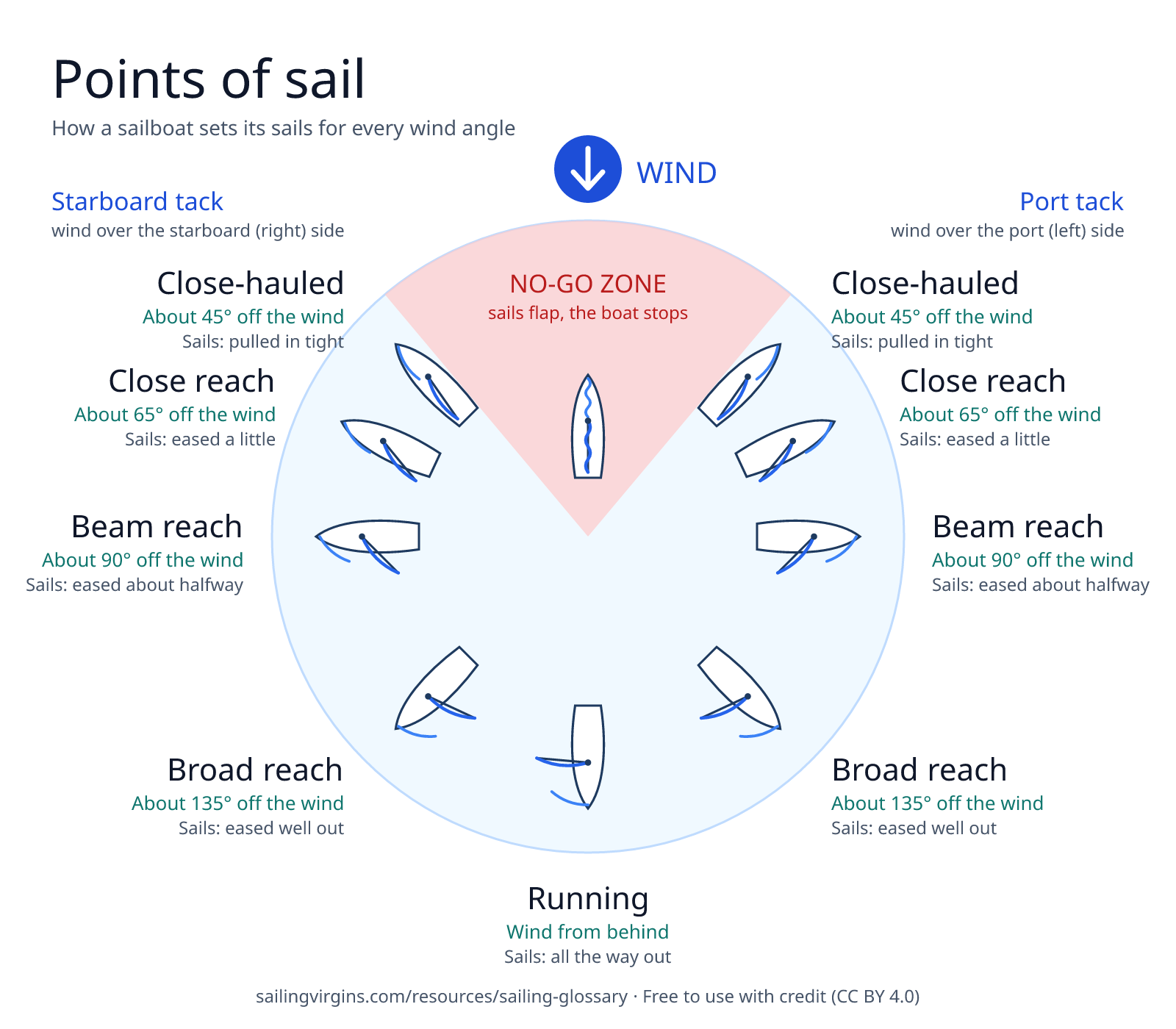
| Point of sail | Angle off the wind | Sails | Speed | Heel |
|---|---|---|---|---|
| No-go zone | Closer than 40° to the wind | Flapping, no drive | 0.0 knots | 0° |
| Close-hauled | 40° to 52° | Pulled in tight | 5.6 knots | 20° |
| Close reach | 52° to 80° | Eased a little | 6.7 knots | 17° |
| Beam reach | 80° to 100° | Eased about halfway | 7.3 knots | 12° |
| Broad reach | 100° to 165° | Eased well out | 6.8 knots | 6° |
| Running | 165° to 180° | All the way out | 5.2 knots | 1° |
Speed and heel are for a typical 40-foot cruising yacht in a steady 12-knot breeze. The no-go zone is the arc of roughly 40° to 45° either side of the wind direction in which a sailboat cannot sail, because its sails can only flap instead of filling.
sailingvirgins.com/resources/sailing-glossary/how-sailing-works · Free to use with credit (CC BY 4.0)
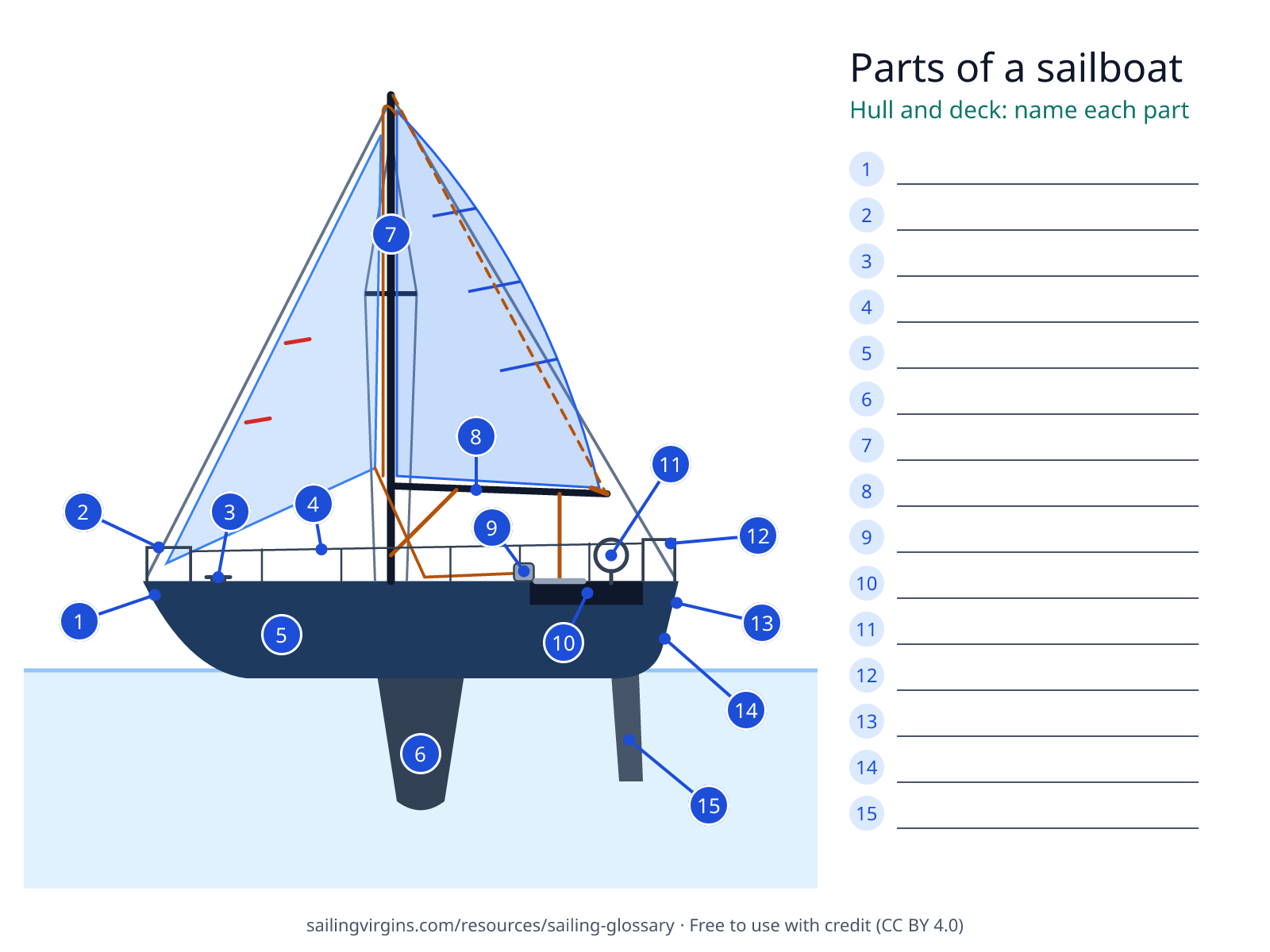
Parts of a sailboat: hull and deck
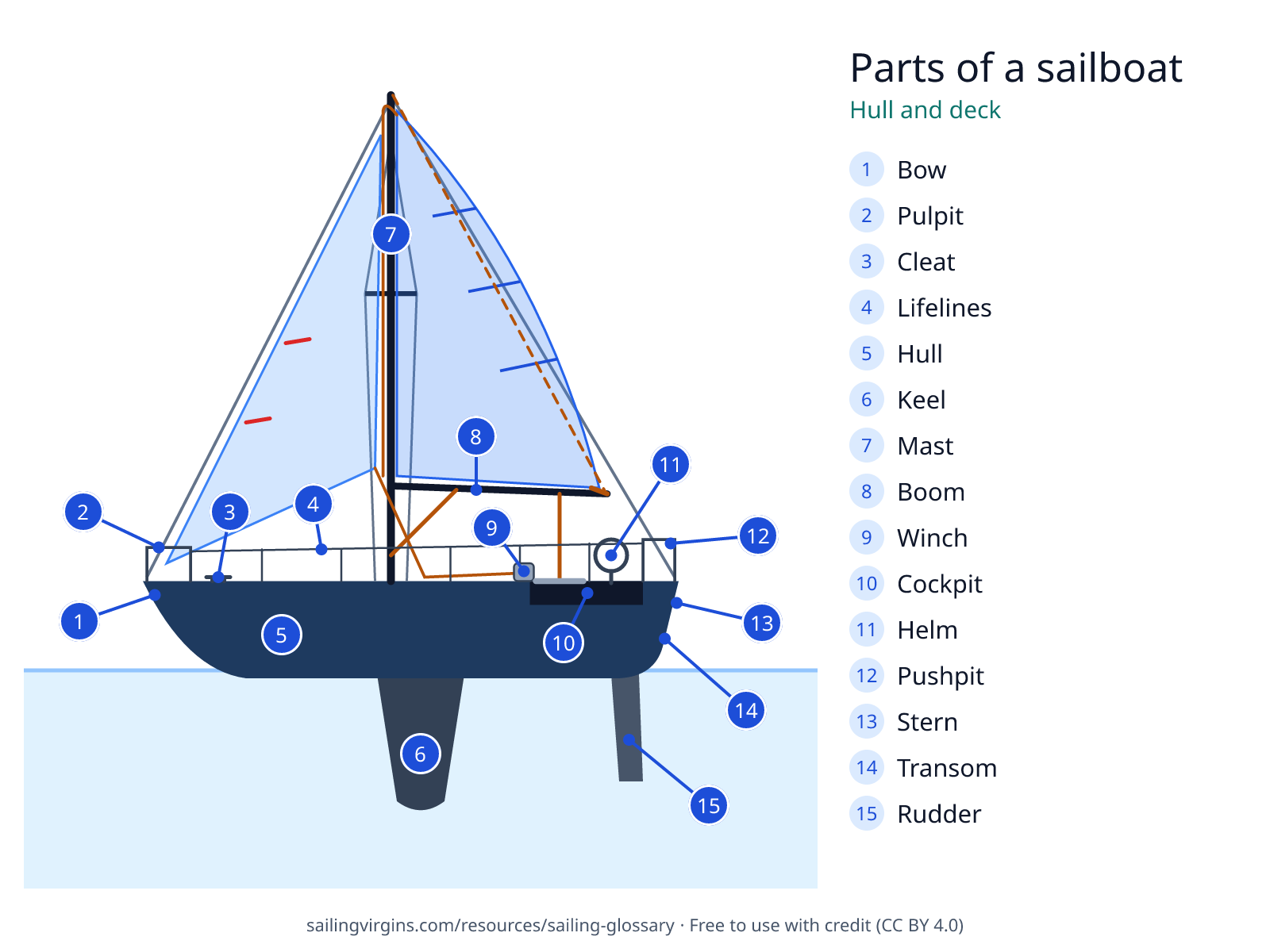
- 1. The bow is the forward-most part of a boat.
- 2. The pulpit is the raised guardrail at the very bow (or stern, where it's called the pushpit) of a boat.
- 3. A cleat is a fitting with two projecting horns around which a line is wrapped and secured.
- 4. Lifelines are the wire or rope railings, supported by stanchions, that run around the outer edge of the deck to help stop crew falling overboard.
- 5. The hull is the main body of a boat — everything below the deck that displaces water and keeps you afloat.
- 6. The keel is the fixed fin beneath the hull that provides stability, resists sideways sliding, and (on most sailboats) houses ballast weight.
- 7. The mast is the vertical spar that holds up the sails and rigging.
- 8. The boom is the horizontal spar that extends from the base of the mast and holds the foot of the mainsail taut.
- 9. A winch is a geared mechanical drum used to multiply the crew's pulling force when hauling in a sheet or halyard.
- 10. The cockpit is the recessed area, usually near the stern, where the crew sits or stands to steer and handle the sails.
- 11. The helm is the wheel or tiller used to steer a boat, and by extension the term for whoever is steering it.
- 12. The pushpit is the raised guardrail at the stern, mirroring the pulpit at the bow.
- 13. The stern is the rear-most part of a boat.
- 14. The transom is the flat (or sometimes curved) structure across the stern of the hull.
- 15. The rudder is the underwater blade at the stern that steers the boat by deflecting water flow.
sailingvirgins.com/resources/sailing-glossary/how-sailing-works · Free to use with credit (CC BY 4.0)
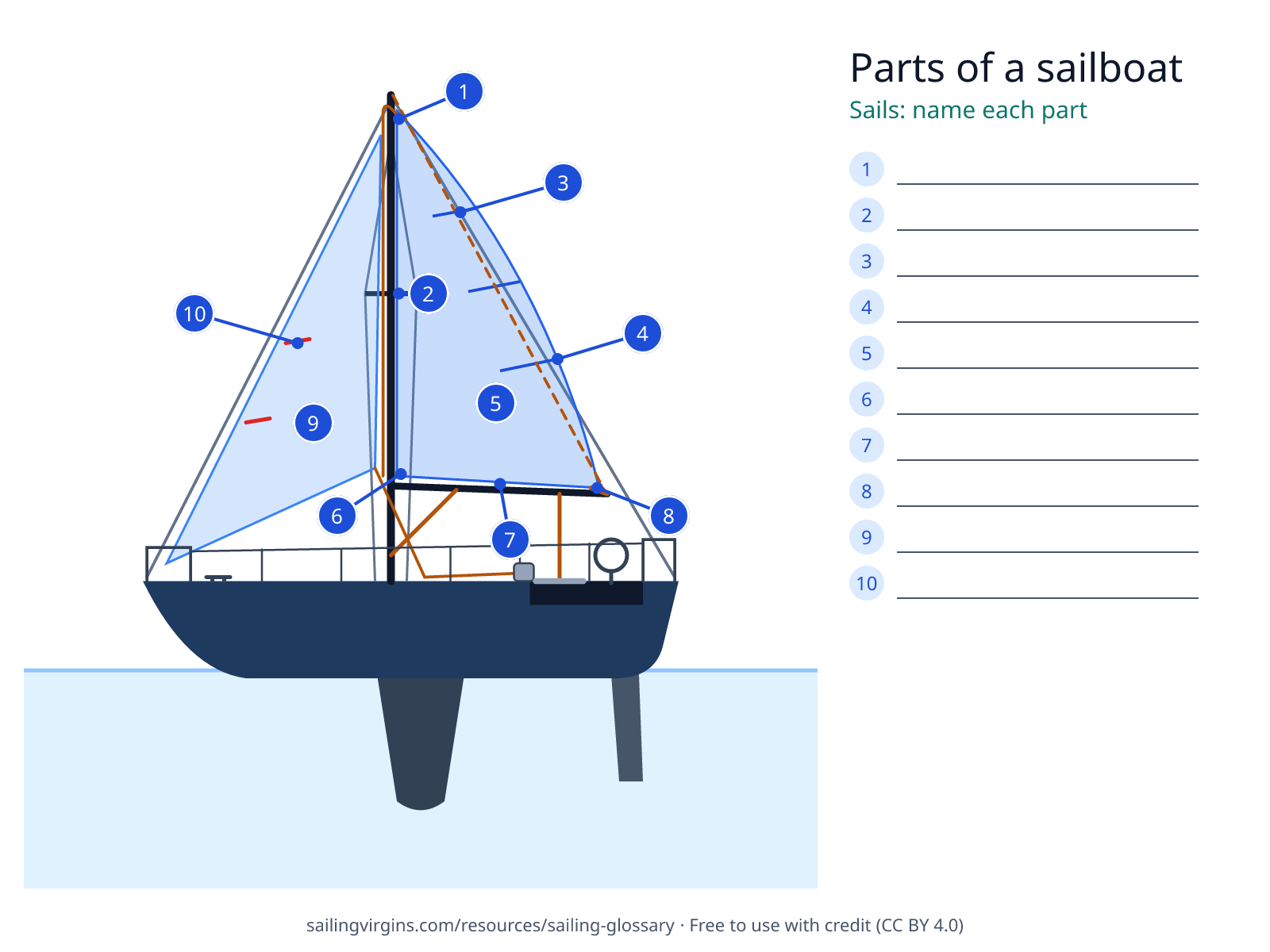
Parts of a sailboat: sails
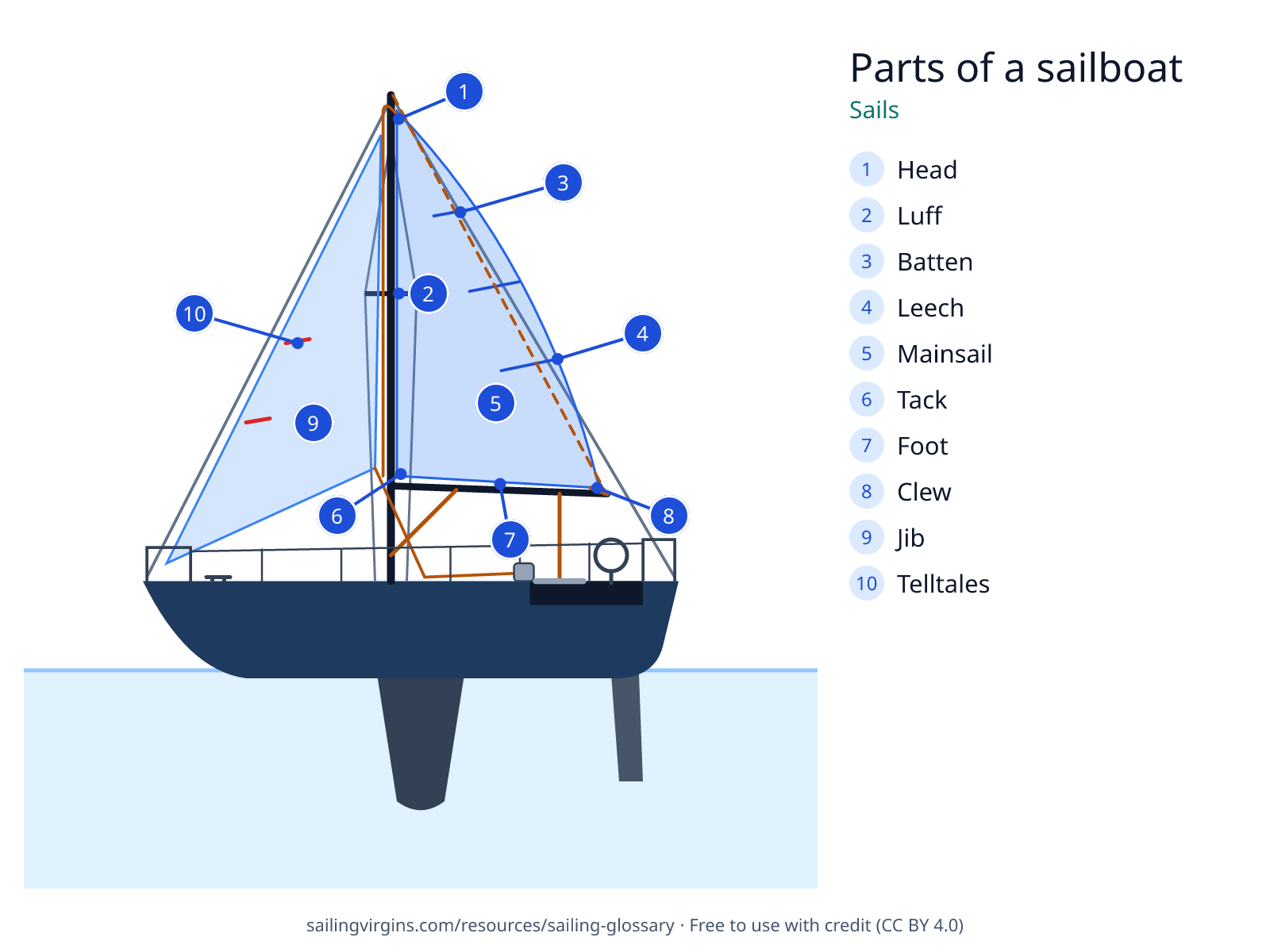
- 1. The head of a sail is its top corner, where the halyard attaches to hoist it.
- 2. The luff is the forward (leading) edge of a sail, the part that meets the wind first.
- 3. A batten is a rigid strip inserted into a pocket in the sail's leech to help it hold its shape.
- 4. The leech is the trailing (back) edge of a sail, running from the head to the clew.
- 5. The mainsail is the primary sail set on the aft side of the mast, attached to the boom along its foot.
- 6. The tack is the forward lower corner of a sail, where the luff meets the foot.
- 7. The foot is the bottom edge of a sail, running from the tack to the clew.
- 8. The clew is the aft lower corner of a sail, where the sheet attaches.
- 9. A jib is a triangular headsail set forward of the mast, smaller than a genoa and typically not overlapping the mast.
- 10. Telltales are short lengths of wool or ribbon attached to a sail to show the airflow across its surface.
sailingvirgins.com/resources/sailing-glossary/how-sailing-works · Free to use with credit (CC BY 4.0)
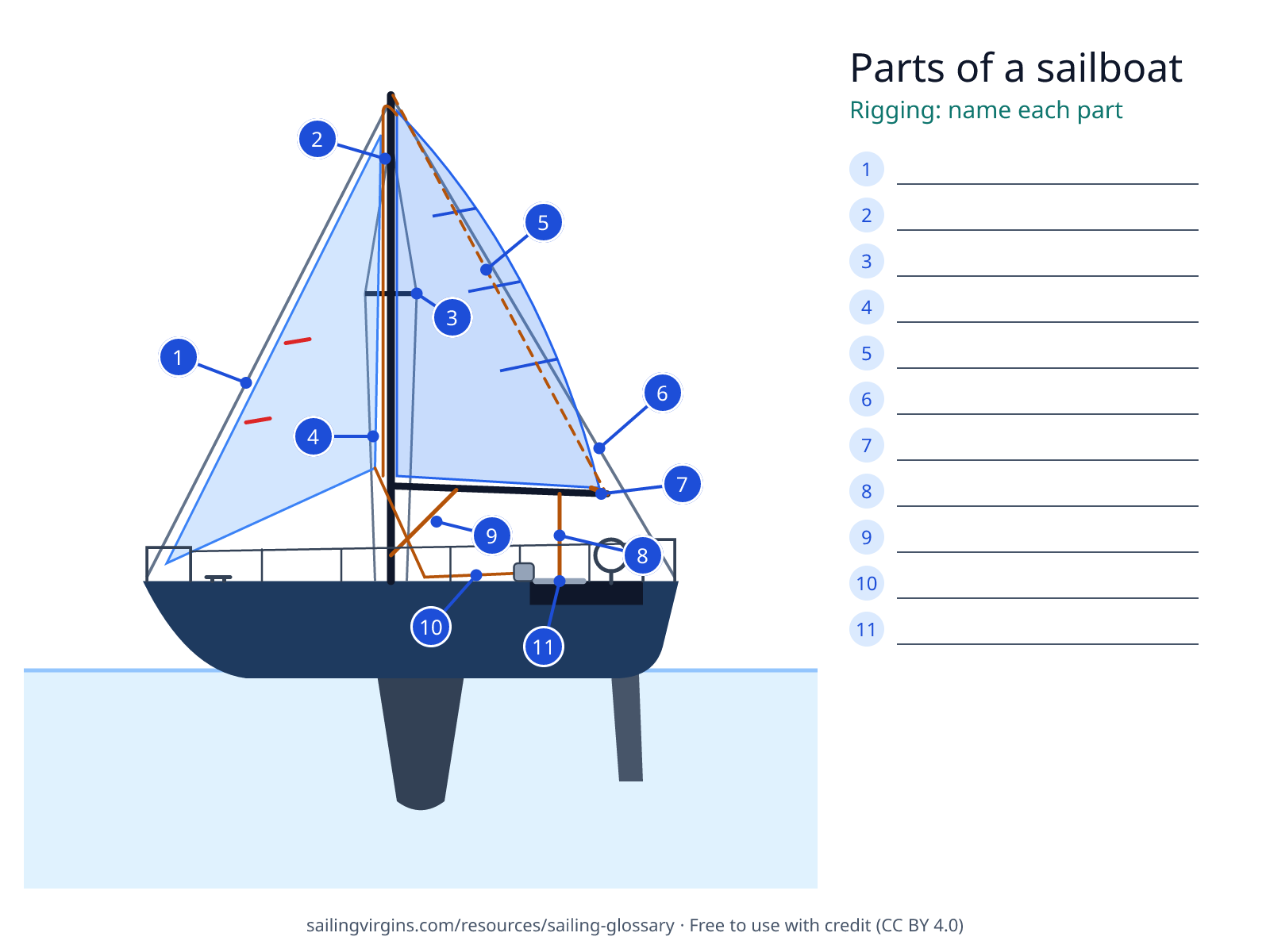
Parts of a sailboat: rigging
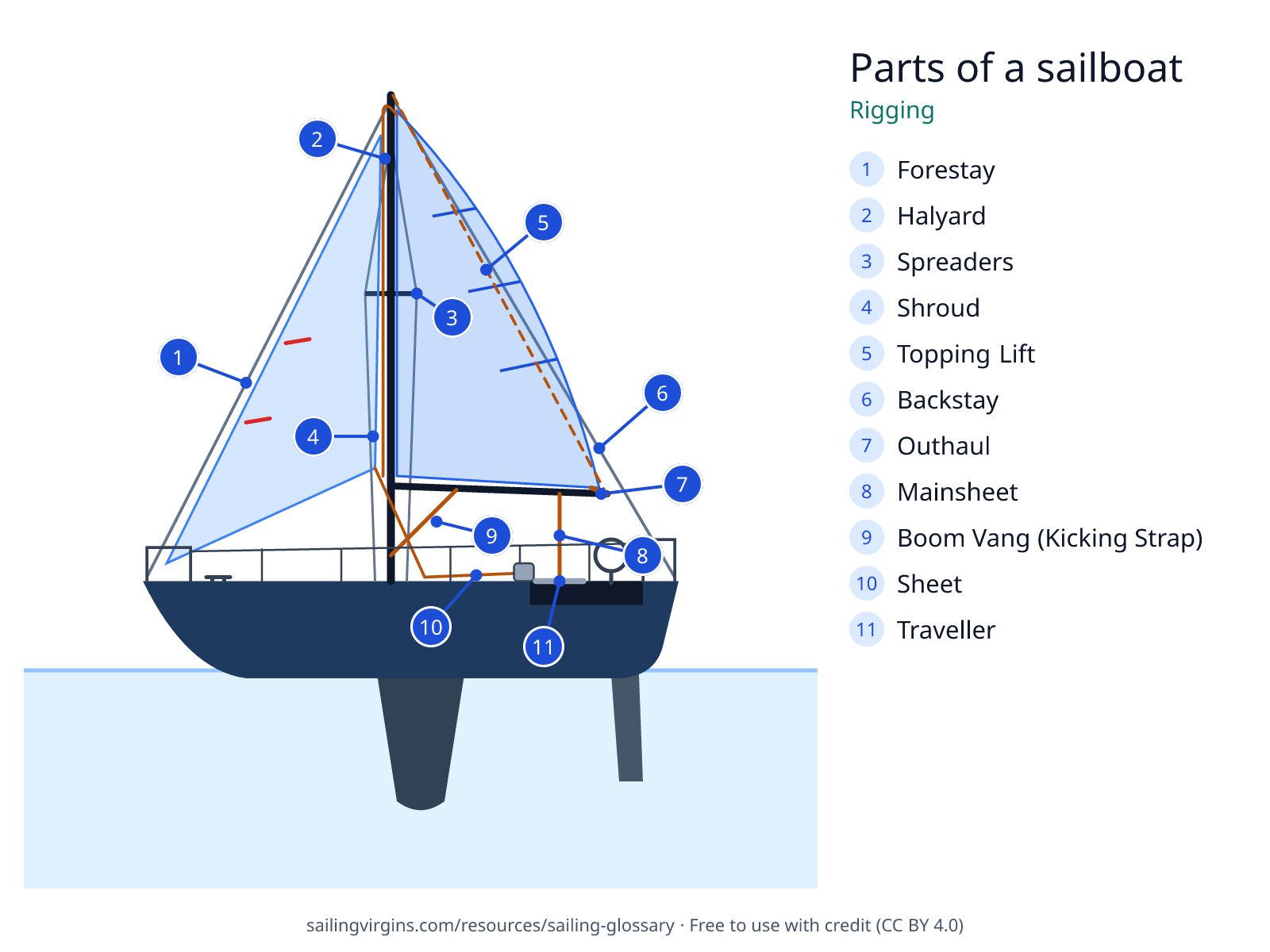
- 1. The forestay is the standing rigging wire running from the bow to the top (or partway up) the mast, and it usually carries the headsail.
- 2. A halyard is a line used to hoist a sail up the mast.
- 3. Spreaders are horizontal struts partway up the mast that hold the shrouds out at an angle, improving their ability to support the mast sideways.
- 4. A shroud is a wire or rod that runs from the mast to the sides of the deck to support it laterally.
- 5. A topping lift is a line that supports the boom (or spinnaker pole) when the sail isn't hoisted or under load.
- 6. The backstay is the standing rigging wire running from the top of the mast to the stern, balancing the forward pull of the forestay.
- 7. The outhaul is the line that tensions the foot of the mainsail by pulling the clew towards the end of the boom.
- 8. The mainsheet is the line used to control the angle of the mainsail relative to the wind.
- 9. A boom vang — called a "kicking strap" in British and Australian usage — is a line or hydraulic ram that pulls the boom down to control mainsail twist.
- 10. A sheet is a line used to control the angle of a sail to the wind by pulling it in or letting it out.
- 11. A traveller is a track and car system, usually mounted across the cockpit, that lets the mainsheet's attachment point move side to side.
sailingvirgins.com/resources/sailing-glossary/how-sailing-works · Free to use with credit (CC BY 4.0)
Parts of a sailboat worksheet: hull and deck
Name: ______________________
Write the name of each numbered part on its line.
sailingvirgins.com/resources/sailing-glossary/how-sailing-works · Free to use with credit (CC BY 4.0)
Parts of a sailboat worksheet: sails
Name: ______________________
Write the name of each numbered part on its line.
sailingvirgins.com/resources/sailing-glossary/how-sailing-works · Free to use with credit (CC BY 4.0)
Parts of a sailboat worksheet: rigging
Name: ______________________
Write the name of each numbered part on its line.
sailingvirgins.com/resources/sailing-glossary/how-sailing-works · Free to use with credit (CC BY 4.0)