
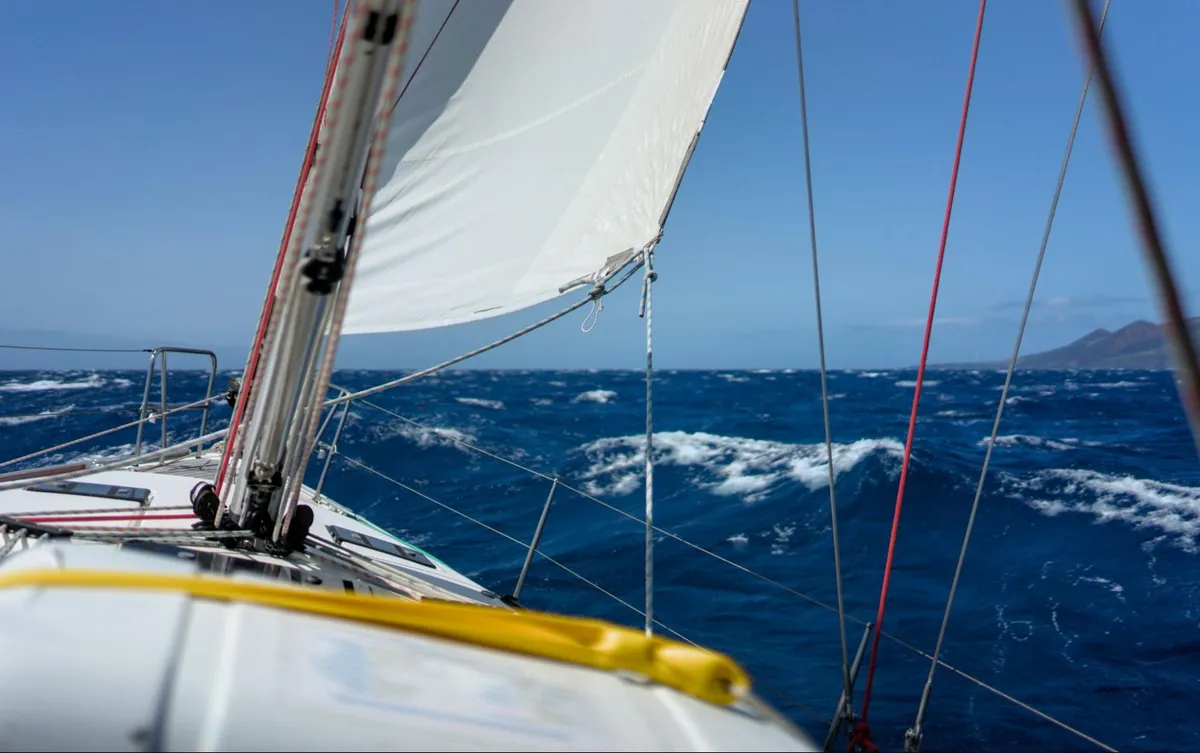
Storm sailing basics cover the work you do before, during, and after heavy weather at sea. Most sailors encounter their first gale by accident. Wind and sea conditions can change faster than any forecast suggests, so you sail with whatever preparation you have on board.
This guide breaks it down into three phases: what to do before you leave, how to manage the boat when the storm hits, and what to do after it's over.
Every step here is something you can practice in fair weather.
Photo by Benjamin Genz on Unsplash
Prep Your Sailboat Before the Forecast Turns
Your storm response starts at the dock. Prepare everything below before you depart.
Inspect on a schedule: Check the hull, rigging, and engine at set intervals. A mechanical failure at 35 knots turns a hard day into an emergency.
Leave the glass at home: Bring plastic or metal, since glass shatters once the boat starts tossing gear around. Label the cans so you can spot them with a headlamp.
File a float plan: Write down your route, your estimated time of arrival (ETA), and two emergency contacts. Seal documents and spare batteries in a dry bag.
Carry backup comms: Cell towers can fail in severe weather, so a phone alone isn't a plan. Add a very high frequency (VHF) radio or a satellite phone.
Pack a grab bag: Fill one waterproof bag with water, flares, a handheld VHF, and your emergency position indicating radio beacon (EPIRB). Keep it by the companionway.
Drill under blue skies: Practice man-overboard recovery while the water is flat. Everyone should know where you stow the life raft.
These preparations are quick to complete, and they all pay off within the first ten minutes of a squall.
Check the Weather Before and During Your Passage
Your weather forecast does half the work when sailing in heavy weather. Check marine weather apps and VHF weather channels the night before and again at dawn.
Learn the Beaufort scale so a forecast for Force 7 means something concrete. Force 6 covers 22 to 27 knots. Force 7 runs 28 to 33, with foam blowing in streaks off the crests.
Out on the water, watch for towering clouds with dark, flat bases. A sudden shift in wind direction or a drop in temperature that you can feel often comes before a squall.
The swell tells you more. When it steepens or a second wave train arrives from a new angle, a weather system may be approaching.
Shorten Sail Before the Gust Finds You
Reefing means shortening the sail so the wind has less canvas to push against. A reefed sailboat sails more steadily, with less heel and a lighter helm.
The moment the thought "should we reef?" crosses your mind, you have your answer. Reef your sails in stages as the wind climbs, one step at a time.
Tucking in a reef at 18 knots takes four minutes on a level deck. The same job at gale force costs fifteen, with spray in your eyes and one hand for the boat.
Reef the main first, then furl the headsail to match. An unbalanced rig loads up the rudder. The boat rounds up, swinging its bow hard into the wind.
Above 35 knots, swap the rolled-up headsail for a storm jib. Storm sails are cut flat from heavy cloth. They sheet inside the shrouds, so they sit nearer to the centerline.
A rolled-up genoa keeps a deep belly at that wind speed. All that belly heels the boat over and drags the bow down.
Storm Tactics for the Deck and Cockpit
Once the squall arrives, your job narrows to the boat and the people on board. First, put on your life jacket. Everyone needs to wear one. Clip harnesses to the jacklines, the webbing straps running bow to stern along the deck.
Then secure the deck. Anything loose becomes a projectile, so stow the winch handles and lash the dinghy. Dog the hatches, meaning latch them down hard so no water gets below.
Slow down; it gives the boat time to meet each wave and eases shock loading on the rig.
Switch on your navigation lights even at midday, since visibility drops in heavy rain. During a lightning storm, keep low in the cockpit and keep your hands off the wheel pedestal, the shrouds, and the mast.
Put distance between the boat and land. Head for open water where the seas have space to roll under you, away from rocks and shoals. Report your position on VHF channel 16, the distress and calling channel.
Three Ways to Ride the Storm Out
Once the wind tops your comfort zone, the rhumb line stops being the plan. That's the straight track to your destination, and holding that course in a gale punishes the boat.
A sailboat lying beam on, with seas breaking against its side, risks capsizing. These three storm tactics give the crew a break and put the boat at a safer angle.
Heave-To
Tack the boat while keeping the headsail sheet tight. This way, the jib will back against the new windward side. That backed jib pushes the bow to leeward while the reefed main pushes it to windward. Lock the rudder to windward, and the two forces cancel out.
The boat rests at roughly 50 degrees off the wind. It drifts a knot or so sideways, leaving a slick of flat water to windward. That slick knocks down the worst of the seas.
Run Downwind Under Bare Poles
When waves get too big to meet head-on, run off with the strong wind. Drop all sail and steer off with the stern square to the seas.
Trail warps behind you if the boat starts surfing down the wave faces. Warps are heavy lines streamed astern in a loop, and the drag holds your speed down.
Deploy a Sea Anchor
Think of a sea anchor as a parachute streamed from the bow on a long rode. The rode is the line joining it to the boat. The sea anchor keeps the bow pointed into the seas and slows your drift to a crawl.
Use one when you'd rather wait out the worst than steer through the night. You'll want plenty of sea room to leeward first.
Clarify the Chain of Command Before You Sail
A gale erases speech at ten feet. Your crew will catch about a third of what you shout, so plan around that beforehand.
Use simple words and avoid jargon. Start with the crew member's name, then give the order. Wait for a reply after that.
Settle the hierarchy at the dock. One captain gives orders in heavy weather, and everyone else repeats them back before they move.
When to Turn Back and When to Press On
The hardest choices are yours to make, and the weather won’t wait for you. Know your limits. If your crew has never handled 30 knots, you know whether to go on.
Name a Plan B and a Plan C before departure. Your first harbor might become untenable in this wind direction. Write down the backup harbors and the depth at each entrance.
Turning back early counts as seamanship. Experienced sailors are usually the ones who call it off soonest.
What to Do After the Storm Passes
Head count first. Ask every person by name how they're doing. Watch their faces, since seasickness and shock both hide behind a thumbs up.
Next comes the boat. Walk the deck looking for rig damage and look up the mast for a bend. Check the bilge for water that doesn't belong there.
Test the electronics one at a time. A soaked chartplotter or a dead radio changes your plan for the next leg. Radio the marina or call your family with your position and status.
Log the incident with the time, the wind speed, and any damage. Insurers and yards both ask for the incident log.
If you think there’s structural damage or engine issues, get a professional survey before your next trip. Finish with a debrief while everyone still remembers it, and ask what worked and what didn't.
Practice Storm Sailing Basics With Sailing Virgins
Reading about a reefing sequence and doing one in 30-knot winds are different skills. Heavy weather teaches you through your hands, and it helps to have an instructor beside you when it does.
Sailing Virgins runs offshore and advanced ASA courses in conditions that actually test you. The advanced track pairs ASA 105 Coastal Navigation with ASA 106 Advanced Coastal Cruising, so you plot a passage one day and sail it in a breeze the next.
Seven days aboard means you meet weather on its own schedule, including at night. With six students to a boat, you take the helm during the rough hours rather than watching someone else do it.
Book an advanced course and learn storm sailing basics from the helm.