
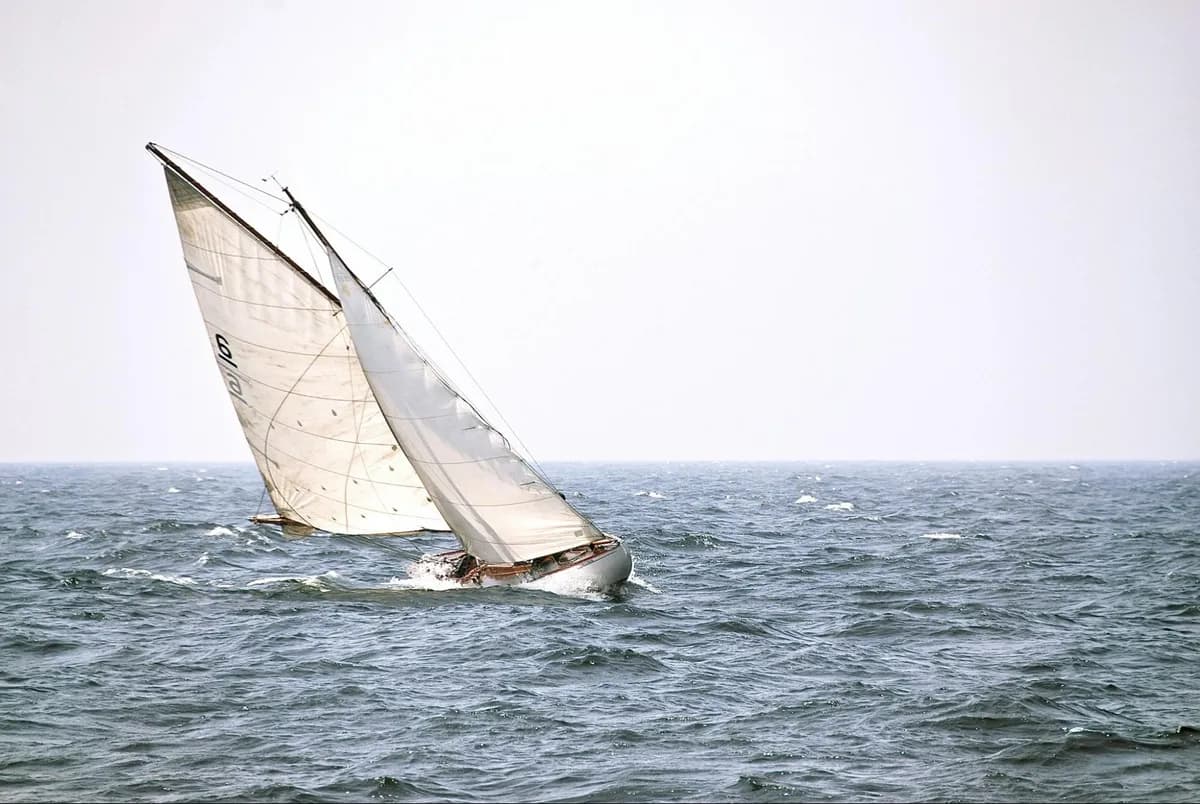
The water looks like glass, the sails barely hold their shape, and your destination is still three miles away. Before starting the engine, focus on one goal: keep the boat moving.
In light wind, small gains in speed help maintain airflow over the sails. Sail trim, crew position, and smooth steering all matter, but speed comes before pointing. Start by setting the sails for power without over-trimming them.
How Apparent Wind Changes in Light Air
Apparent wind is the wind experienced on a moving boat. It combines the true wind with the airflow created by the boat’s motion, so its strength and direction change as the boat accelerates or turns.
Upwind and on a reach, additional boat speed generally strengthens the apparent wind and shifts it forward. Downwind, sailing too deep can reduce the apparent wind and cause the sails to collapse. That is why preserving momentum is so important in light air.
Add Power Without Overfilling the Sails
Light wind often calls for slightly fuller sails, but the goal is not to make them as baggy as possible. Too much depth or leech tension can stall the airflow. Aim for a smooth, powered-up shape and use the telltales to determine whether each adjustment helps.
Ease the Halyard and Outhaul Slightly
Reduce halyard tension until you see only a hint of horizontal wrinkling near the luff. Ease the outhaul slightly if the lower third of the mainsail looks too flat.
Avoid large adjustments. If the wrinkles become pronounced or the sail develops an excessively deep pocket, add some tension back. Exact settings vary by sail design and boat, so make one adjustment at a time.
Use the Telltales as Your Guide
Upwind, aim to keep the telltales on both sides of the jib streaming aft. If the windward telltale lifts, bear away a few degrees. If the leeward telltale stalls, ease the sheet slightly.
When reaching, ease the sheet until the front of the sail begins to flutter, then trim just enough to steady it. This keeps the sail powered without over-trimming it.
Open the Top of the Sail With Twist
Wind near the masthead is often stronger and may come from a slightly different direction than the wind at deck level. Twist allows the upper and lower sections of the sail to meet that airflow at more effective angles.
With the boom vang eased, ease the mainsheet until the upper leech opens and the top telltale streams aft. Then move the traveler to windward as needed to position the boom without closing the leech.
If the upper telltale repeatedly disappears behind the sail or the top batten hooks to windward, the mainsail is probably over-trimmed.
If the Mainsail Is Already Full
If the mainsail already has plenty of depth, do not ease the outhaul further. Keep the lower third controlled, preserve twist with the mainsheet, and use the traveler to position the boom.
Backstay tension, mast bend, and rig tuning vary significantly between boats. Follow the sailmaker’s tuning guide rather than applying one setting to every cruising yacht.
Use Crew Weight to Reduce Drag and Hold Sail Shape
On a monohull, a small amount of leeward heel can help gravity hold the sails in shape when there is not enough wind pressure to do it naturally. Keep the crew close together and near the center of the boat, then adjust their fore-and-aft position by watching the wake.
If the stern squats or the transom drags through the water, move some weight slightly forward. The ideal position depends on the hull design, so avoid assuming everyone should always sit near the shrouds.
Move only one person at a time and do it smoothly. Abrupt movement rocks the boat and disrupts airflow. As the breeze increases, shift weight back toward windward as needed to maintain an efficient heel angle.
Build Speed Before Pointing Higher
If the boat is slow or stalled, bear away a few degrees—just far enough to fill the sails and get the telltales streaming. As speed returns, head up gradually. Stop as soon as the windward telltales lift or the boat begins to slow.
This is the essence of footing instead of pinching: sacrificing a little pointing angle to maintain enough speed to make progress.
Keep rudder movements small and smooth because large corrections create drag. In shifty conditions, the helm and trimmers should work together. Steer a stable course while the sails are eased or trimmed gradually to maintain airflow.
Keep the Pressure Up When Sailing Downwind
Sailing directly downwind is often slow in light air because the boat moves away from the true wind, reducing the apparent wind over the deck.
Head up until the sails fill and you feel pressure return to the sheets. Once the boat accelerates, bear away gradually. If the pressure disappears, head up and rebuild speed again.
Sailing a longer distance at a faster angle can get you to your destination sooner than pointing directly at it with collapsing sails.
Protect Your Momentum Through Every Maneuver
Once the boat is moving, avoid giving away that hard-earned speed.
Build speed before maneuvering: Accelerate before a tack or gybe, then make the turn smoothly.
Limit crew movement: Move one person at a time and keep movements slow and controlled.
Watch the boat and water: Telltales, wake, ripples, and bubbles already in the water can reveal changes in speed before they appear on an instrument.
Practice Light Wind Sailing on a Sailing Virgins Course
Where do you practice any of this? Join our week-long liveaboard courses on a 40-foot sailboat. You can choose from the British Virgin Islands, Croatia, or French Polynesia.
Our beginner course prepares complete newcomers to earn ASA 101 and ASA 103 certifications. No prerequisites needed. You'll learn points of sail, sail trim, gybing, anchoring, and overboard recovery.
Our intermediate course includes ASA 104 training for sailors developing the skills needed to skipper larger cruising yachts and prepare for bareboat chartering. Passage planning, heavy weather technique, and night sailing are featured.
A full week on the water gives you repeated opportunities to adjust the sails, test different steering angles, and experience changing conditions. Explore our courses and learn how to keep a sailboat moving when the breeze fades.